|


| Quantity: | |
|---|---|
Product Description
Within a collaborative sensing system, the SX-2821 Multi-Target Tracking Radar serves as the foundational perception unit. Rather than operating in isolation, it acts as the central nervous system for complex security perimeters, providing continuous, high-precision target coordinate data to secondary sensors. By seamlessly feeding exact spatial information to electro-optical tracking equipment (PTZ cameras), acoustic deterrents, and specialized bird repellent systems, it ensures that subsequent countermeasures are guided with absolute precision.
When deployed in the field, operators immediately notice the heavy-duty, cold-to-the-touch aluminum alloy exterior—a physical testament to its rugged engineering designed for unforgiving environments. This radar is widely applicable across critical site protection, the rapidly expanding low-altitude economy, airport bird hazard detection, air traffic control, and demanding border and coastal defense operations. Its silent, solid-state operation ensures that it remains discreet while maintaining an invisible, impenetrable surveillance dome over restricted airspaces and ground perimeters.
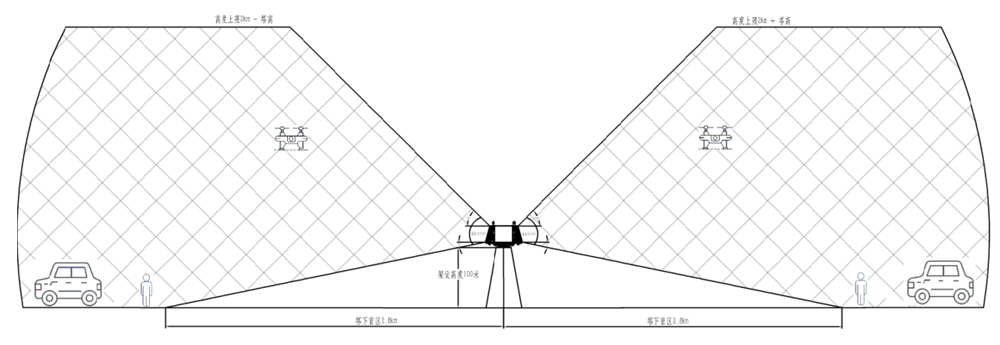
Based on advanced signal processing algorithms and a highly refined system hardware architecture, the radar demonstrates exceptional accuracy in measuring range, velocity, azimuth, and height. This precision translates directly into actionable intelligence, providing command centers with stable sensing data that eliminates guesswork during critical decision-making and target countermeasures.
Featuring a sophisticated 2D Active Electronically Scanned Array (AESA) design, the unit achieves extensive coverage across both azimuth and elevation planes. Supported by a high-performance signal processor, it enables real-time detection and tracking of multiple moving targets simultaneously within the entire field of view. This capacity ensures that complex, large-area scenarios involving drone swarms or multiple ground intruders are handled without system overload.
Under the condition of a high refresh rate, the radar employs advanced tracking filtering algorithms. This significantly enhances its capability to lock onto and continuously track high-speed, highly maneuverable targets—such as evasive UAVs or fast-moving coastal vessels—ensuring the target trajectory remains unbroken on the operator's screen.
Sophisticated clutter suppression technology allows the system to effectively extract weak target signals (like micro-drones) even in complex electromagnetic environments heavily obscured by strong ground reflections or severe weather clutter. By maintaining an extremely low false alarm probability, it prevents operator fatigue and ensures that every alert warrants immediate attention.
The internal architecture contains no mechanical scanning parts or cooling fans. This fully solid-state design not only results in completely silent operation but also drastically reduces the wear and tear associated with moving components. The result is exceptionally high equipment reliability, extended deployment lifespans, and significantly lowered routine maintenance demands.
The system supports Track While Scan (TWS) and Target Tracking (TAS) capabilities, enabling dynamically focused surveillance of multiple distinct targets. The radar beam can be electronically steered in microseconds to prioritize high-threat objects while maintaining general situational awareness.
Built for modern security ecosystems, the radar supports standard network protocols including TCP/IP. This allows it to seamlessly dock with existing C2 (Command and Control) systems, optical tracking devices, and active anti-UAV countermeasures, weaving individual components into a unified, automated defense network.
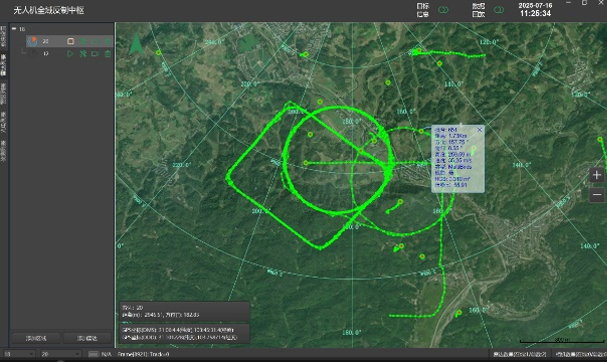
The equipment is paired with an intuitive visual control terminal that simplifies complex airspace data. Featuring AI-assisted target classification, real-time trajectory prediction, and automated defense zone breach alerts, the software drastically lowers the cognitive load and decision-making threshold for security personnel.
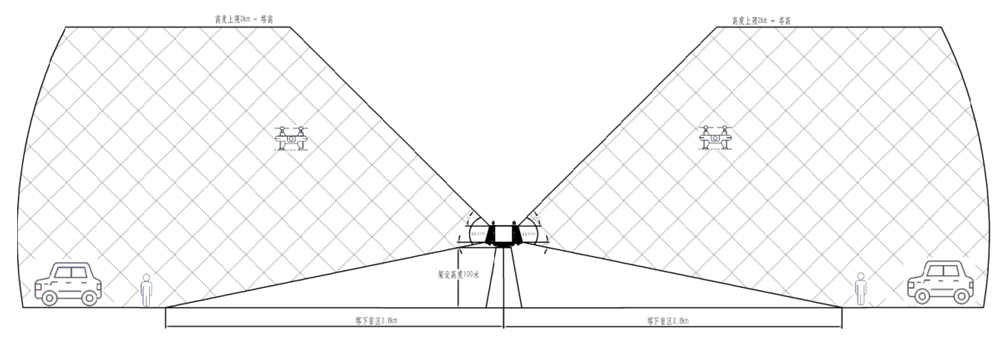
Before leaving the manufacturing facility, every unit undergoes rigorous extreme temperature and electromagnetic compatibility testing to guarantee industrial and military-grade all-weather performance. The exact operational parameters are strictly calibrated to the values listed below.
1. Operating Band: X-Band
2. Technology: AESA
3. Measurement Range
① Detection Range:≥15km
② Blind Zone: ≤150m
③ Azimuth Coverage: 360°
④ Elevation Coverage: -2°~45°
⑤ Maximum Detection Altitude: 2000m
⑥ Velocity Measurement Range: 1-150m/s
4. Detection Range
① Small UAV (RCS=0.01m², DJI Phantom 4): ≥8km
② Medium UAV (RCS=1m²): ≥15km
③ Car, Chopper (RCS=5m²): ≥15km
5. Measurement Accuracy (RMS)
① Range Accuracy: ≤8m
② Velocity Accuracy: ≤0.5m/s
③ Angle Accuracy: ≤0.3° (Azimuth), ≤0.3° (Elevation)
6. Refresh Rate: 2.5s (TWS), 0.25s (TAS, 2 targets for single array, 8 targets for 4 arrays)
7. Simultaneous Tracking Capacity: ≥2000 targets(400 targets single array) 8 targets (TAS,2 targets for single array)
8. Environmental Adaptability
① Operating Temperature: -40℃~+55℃
② Operating Humidity: ≤90%
③ Protection Rating: IP66
9. Interface/Power Supply
① Power Supply: AC 220V/16A (Circular Aviation Connector)
② Power Consumption: ≤ 3200W (≤800W for single array)
③ Communication: Ethernet (Circular Aviation Connector), supports TCP/IP protocol
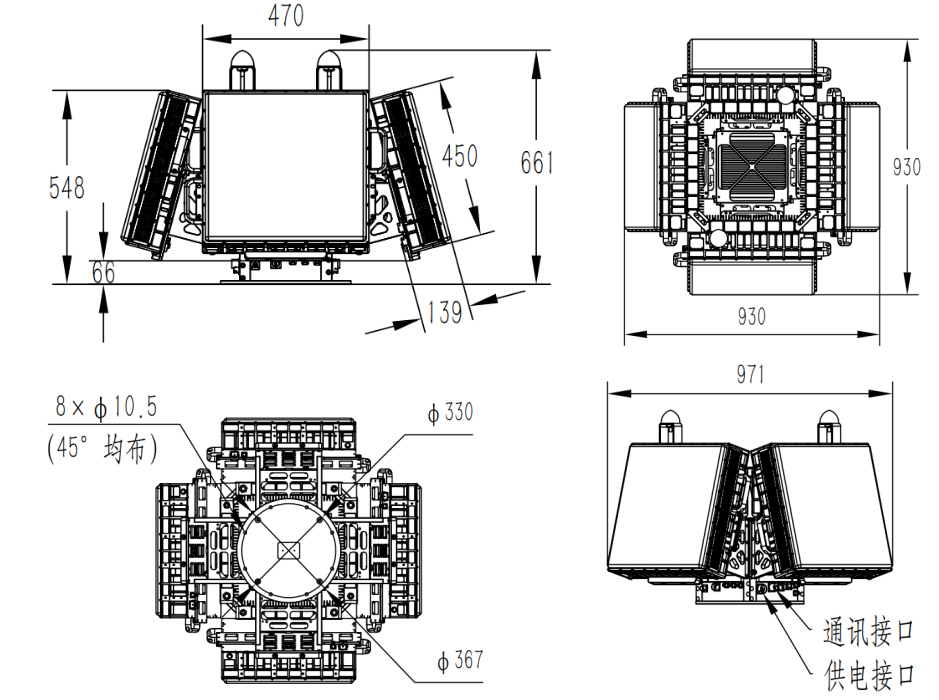
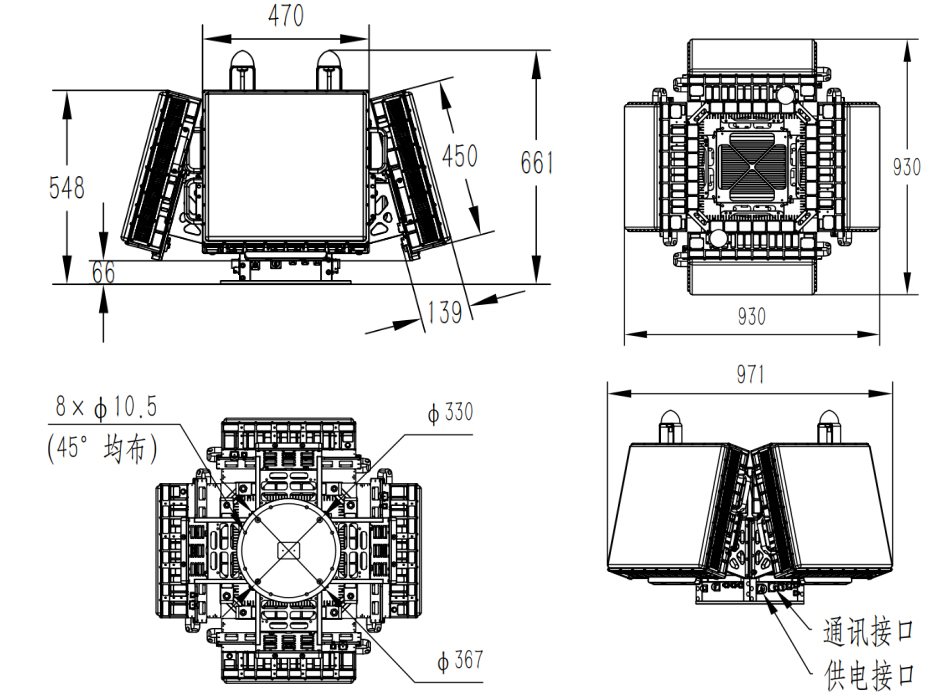
10. Dimensions/Weight: ≤ 140 kg (Four-faced Array)
Item | Dimensions (mm) | Weight (kg) | Packed Dim (mm) | Packed Wt (kg) |
Single-sided Array | ≤520*480*140 | 20kg | ≤780*730*290 | 37kg |
Central Control Unit | ≤890*890*680 | 60kg | ≤960*1030*660 | 110 kg |
Four-sided Array (Including central control unit) | ≤940*940*680 | 140kg | / | / |
Tripod | ≤1100*450*450 | 11kg | ≤1100*450*450 | 14kg |
The system is packaged in protective aluminum alloy transport cases, ensuring the sensitive electronics remain secure during transit. The tactile feedback of the secure latches and the heavy-duty circular aviation connectors highlight the system's readiness for field deployment. Whether opting for a permanent fixed-bracket installation on a perimeter wall or a rapid-deployment tripod setup for temporary event security, the included hardware provides complete deployment flexibility.
No | Name | Qty | Unit | Description |
1 | Radar Host Unit | 4 | Unit |
|
2 | Mounting Bracket | 1 | Set |
|
3 | Tripod | 1 | Unit | Optional, not included by default |
4 | Single Array Transport Case | 4 | Unit | Aluminum Alloy Transport Case |
5 | Bracket Transport Case | 1 | Unit | Aluminum Alloy Transport Case |
6 | Power Adapter | 1 | Cable | AC 220V/16A, Length 15m |
7 | Communication Cable | 1 | Cable | Connects Radar to Display & Control Terminal, Length 15m |
8 | Assembly Tools & Screws | 1 | Set | For assembling Host, Pedestal, Tripod |
9 | Document | 1 | Copy | User Manual, etc. (Electronic Version) |

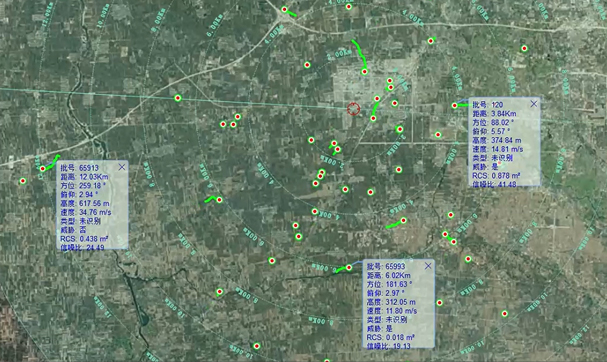
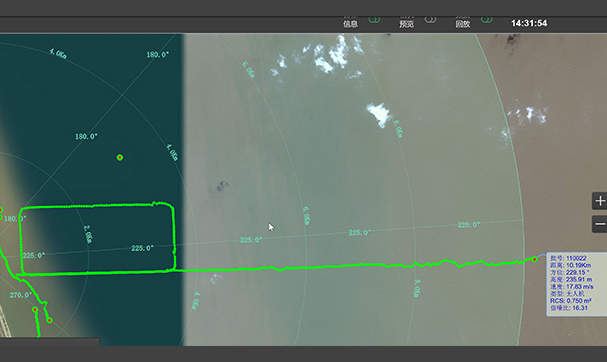
Radar Detecting Small UAVs: Effectively identifying low-RCS targets like commercial drones before they breach critical perimeters.

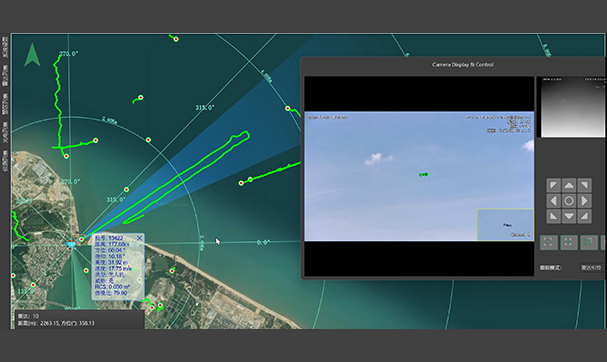
Radar and Camera Coordinated Detection of Sea Surface UAV: Seamlessly guiding optical sensors to visually confirm radar contacts over water.

Radar Detecting Sea Surface UAVs: Overcoming wave clutter to maintain a consistent track on fast-moving maritime surface threats.

Radar Detection of Multi-Target Small UAVs: Managing complex swarm scenarios by tracking dozens of independent aerial coordinates simultaneously.
Deploying a sophisticated multi-target tracking radar requires more than just hardware delivery. We provide comprehensive full-lifecycle technical support, beginning with initial site surveys and tailored solution designs, through to on-site installation, system calibration, and hands-on operator training. This ensures that complex security projects are not only implemented smoothly but are maintained for long-term operational readiness.
Understanding that security requirements vary heavily by region and application, the system is built with extensive customization capabilities. The underlying data interfaces and software architecture are open for secondary development, allowing integration into proprietary command systems. Furthermore, hardware parameters can be adjusted to comply with specific national frequency regulations or unique industry demands.
The practical effectiveness of this radar is proven across numerous real-world deployments. From continuous bird hazard monitoring at international airports to anti-smuggling early warning systems along rugged coastlines and low-altitude drone defense at critical energy facilities, its interception and monitoring capabilities have been rigorously field-tested and validated by operators worldwide.