

 |


| Quantity: | |
|---|---|
Product Description
Drone Countermeasure Vehicle
1. Parameters of Anti-UAV EquipmentThe parameters of the core anti-UAVequipment in this solution are as follows:
1.1 Radar Detection SubsystemThe radar adopts active phased array technology with high-precision detection capability.Detailed indicators are shown in Table 1.
Table 1: Parameters of Radar Detection Subsystem
No. | Item | Specification |
1 | Operating Frequency Band | X-band |
2 | Technical Architecture | Mechanical Scanning in Azimuth + Electronic Scanning in Elevation |
3 | Maximum Vehicle Inclination | ≤ ±3° (Fixed Deployment)≤ ±10° (On-the-Move Deployment) |
4 | Maximum Vehicle Speed | ≤ 40 km/h (On-the-Move Deployment) |
7 | Detection Blind Zone | 50 m |
8 | Azimuth Coverage | 360° |
9 | Elevation Coverage | -5° ~ 40° |
10 | Velocity Measurement Range | 1 – 150 m/s (Fixed Deployment)5 – 150 m/s (On-the-Move Deployment) |
11 | Detection Performance | Fixed Deployment:Small UAV (RCS=0.01 ㎡, Phantom 4): ≥ 5 kmMedium UAV (RCS=1 ㎡): ≥ 10 kmVehicles, Helicopters (RCS=5 ㎡): ≥ 10 kmOn-the-Move Deployment:Small UAV (RCS=0.01 ㎡, Phantom 4): ≥ 4 kmMedium UAV (RCS=1 ㎡): ≥ 10 kmVehicles, Helicopters (RCS=5 ㎡): ≥ 10 km |
12 | Measurement Accuracy (RMS) | Fixed Deployment:Range Accuracy: ≤ 5 mVelocity Accuracy: ≤ 0.5 m/sAngle Accuracy: ≤ 0.4° (Azimuth), ≤ 0.4° (Elevation)On-the-Move Deployment:Range Accuracy: ≤ 10 mVelocity Accuracy: ≤ 1 m/sAngle Accuracy: ≤ 0.8° (Azimuth), ≤ 0.8° (Elevation) |
13 | Refresh Rate | 2 s (30 rpm, Standard), 3 s (20 rpm), 1 s (60 rpm, Upgradable) |
14 | Maximum Tracked Targets | ≥ 200 targets |
2.2 Parameters of Countermeasure Subsystem
The countermeasure system supports multi-band jamming with directional precision
strike capability. Detailed parameters are shown in Table 2
Table 2: Parameters of Countermeasure Subsystem
No. | Item | Specification |
1 | Jamming Range | ≥3 km (Subject to working conditions: When the drone takes off at 5 km altitude, 100–300 m AGL, the jamming range is ≥2.5 km; for the Yu 2 drone, the jamming range is ≥3 km) |
2 | Jamming Coverage | Horizontal detection angle up to 360° |
3 | Jamming Frequency Band | 740 MHz~840 MHz (50 W)860 MHz~930 MHz (50 W)1170 MHz~1290 MHz (50 W)1400 MHz~1490 MHz (50 W)1560 MHz~1620 MHz (50 W)2385 MHz~2490 MHz (100 W)5150 MHz~5250 MHz (50 W)5725 MHz~5850 MHz (100 W) |
4 | Total Power Consumption | ≤1800 W |
5 | Jamming Response Time | ≤7 s |
6 | Cloud Platform | (1) Equipped with unmanned on-duty and manual control functions; it can automatically realize UAV discovery, identification, alarm, positioning and disposal. The software automatically starts the jamming setup and performs fully automatic follow-up jamming suppression based on the UAV position information monitored by the device. (2) Equipped with black and white list function. (3) Equipped with high-definition GIS system function: presenting information such as surrounding environment and equipment deployment points. (4) Equipped with log playback and statistical records: UAV intrusion log, displaying angle, alarm time, frequency information, playback of UAV intrusion records, and provision of UAV intrusion statistical reports. (5) Equipped with positioning function: the system has GPS positioning function and can mark positions on the map. (6) Equipped with status display function: showing device offline, standby, power failure and abnormal status. |
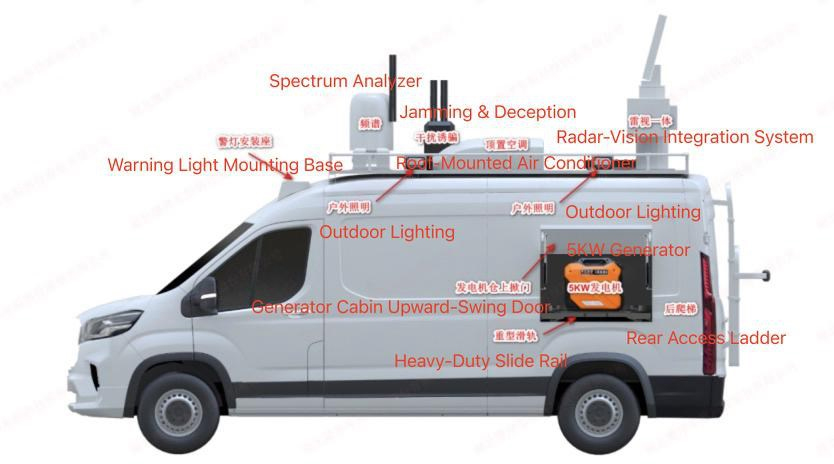
Modified on the basis of the MAXUS V90 chassis, the vehicle adopts a lightweight design and integrates anti-drone equipment, generator, console, display and other components to achieve high intelligence and ease of operation. The layout optimizes space utilization to ensure stable operation of equipment. The vehicle layout is illustrated below: Figure 1 shows the roof equipment layout, including radar antenna, countermeasure modules, etc., with a lifting mechanism for flexible deployment.
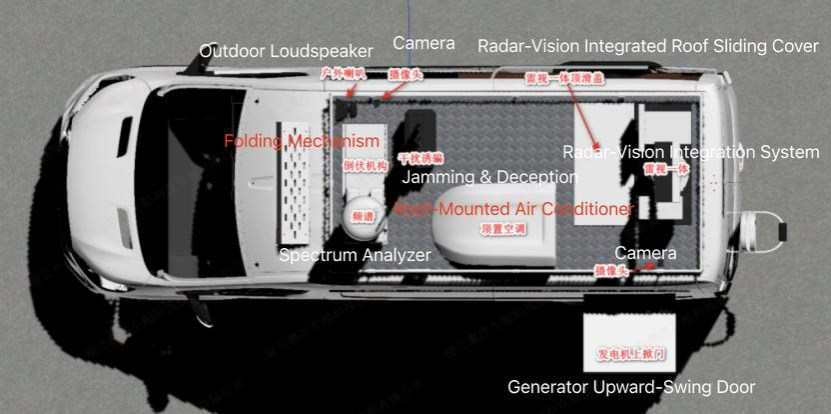
Figure 2 shows the in-vehicle equipment layout, integrating industrial computer, display and power supply system to ensure a comfortable operating space.
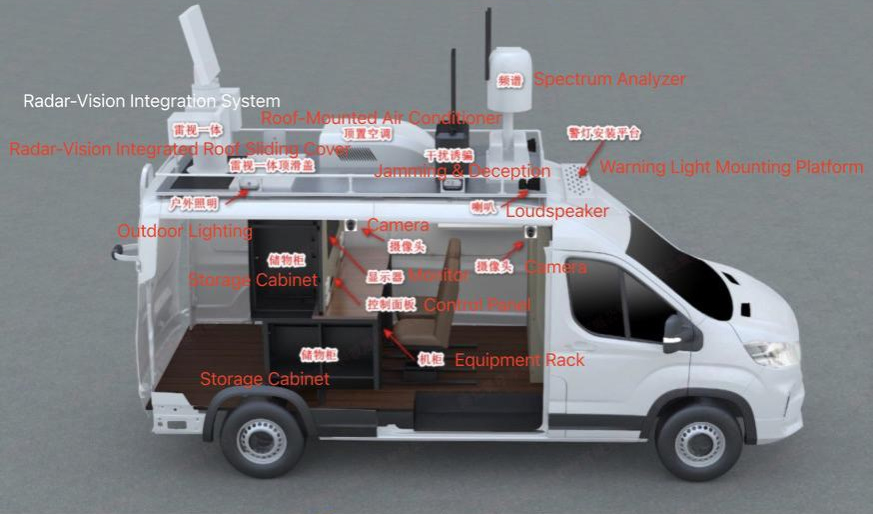
Figure 3 focuses on the rear equipment installation, including power distribution cabinet and cable management to ensure system reliability.
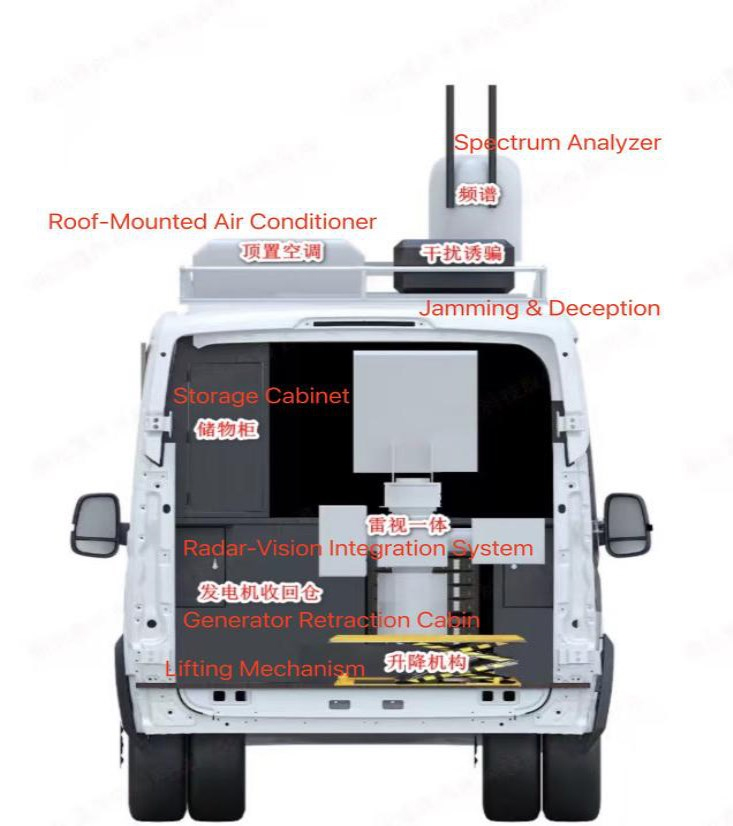
Figure 4 presents the overall vehicle structure from the left side, highlighting equipment integration and body modification details.
1. Overall System Architecture
The system adopts an integrated detection-jamming hardware platform, consisting of three subsystems:
Detection and Perception Subsystem: Realizes target detection, tracking and identification based on active phased array radar.
Intelligent Identification and Decision-Making Subsystem: Processes radar data through Al algorithms for threat assessment and jamming strategy generation.
Countermeasure Execution Subsystem: Implements multi-band directional jamming according to instructions to cut off UAV navigation and remote control links.
All subsystems interact via high-speed bus, ensuring response time below 1 second.
2. Technical Routes of Core Subsystems
Radar Detection Subsystem: Adopts digital beamforming and deep learning clutter suppression technologies to improve detection accuracy in complex environments. Target identification combines RCs characteristics and motion trajectories, using CNN-LSTM model to distinguish UAVs from birds.
Countermeasure Subsystem: Adopts Digital Radio Frequency Memory (DRFM) technology to realize “ tracking jamming” and dynamically adjust beam direction. Supports multi-band cooperative jamming to attack navigation and video transmission links simultaneously.
Integrated Detection & Jamming, Fast Response: Deep hardware integration realizes second-level response of “detect and dispose”
Precise Directional, Electromagnetically Friendly: Phased array beamforming reduces interference to surrounding equipment.
Intelligent Identification, Low False Alarm: AI model effectively filters false targets and improves system reliability.
Software-Defined, Flexible Upgrade: Supports function expansion via software upgrade to adapt to future threats.
It integrates fixed anti-drone equipment with a mobile platform, balancing deployment flexibility and countermeasure effectiveness With reasonable layout and advanced parameters, the system meets diverse application requirements and features high reliability, suitable for various low-altitude security scenarios.


